I've been using the Chromecast for a few days now, and I have to say its a pretty interesting device.
So, you must have read the title and must have an idea what I'm going to do...
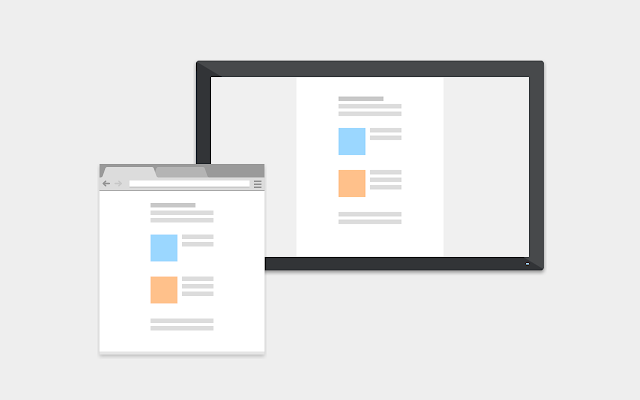
Today I'll show how to cast from your Chrome to your TV using a Chromecast.
To cast from Chrome, you simply need to have the Google Cast Extension installed on your Chrome Browser.
Once you’re set up to Use Chromecast with Chrome, casting a tab is just a few clicks away! To start casting a tab of your Chrome Browser:
Make sure you are on the tab you want to project to your TV.
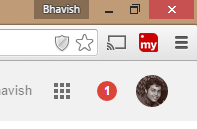
Press the Cast button in the Chrome toolbar (top right hand area) of your browser.
A list of available Chromecast devices will appear on your TV. Pick any device to cast the current tab to this device.
After a very brief load time, the current tab should appear on your TV!
You will see the Cast icon change color to indicate that it is active, and you’ll see a glow around the icon for the tab that is being shown.
If your Chromecast is currently in use – for example, it might already be playing a YouTube video – when you open the menu or select the device, you will see a short description of what Chromecast is doing, possibly with some controls (pause, mute, etc) for that activity. Click the ‘Cast this Tab’ button if you wish to terminate the current activity, and cast the current tab instead. This helps to ensure that you don’t accidentally pick the wrong device and interrupt another household member!
Yes, I know I'm a year late in posting this review. But there was no sign of the Chromecast 2.. And wanted to buy a media streaming device for the TV in my room. I've never been a huge fan of the Cable guys or the Set-Top box as its called... So I was planning on buying streaming device and Google Chromecast was my first and last choice.
SO WHAT IS THE GOOGLE CHROMECAST?
Its basically a low-cost competitor to Apple TV and Roku. It allows you to stream online video and music on your TV using your smartphone, tablet, PC or laptop.
The Chromecast has no resemblance to the Apple TV, Roku or other regular media streaming devices. It consists of nothing more than a small dongle that you plug into your televison's HDMI port, and as a standalone device it does nothing at all – there are no internet channels to watch, nor even any way to control it.
Specifications
HDMI dongle, requires web connection, powered via microUSB
WHATS IN THE BOX?
The box includes, the device along with a short HDMI extension cable in case you can’t plug it in to your TV directly, and it’s powered by an included microUSB cable and mains adaptor. However, if your TV has a free USB port, you can use that to provide power instead. There's nothing else in the box.
HOW TO SET IT UP?
Setup couldn't be any simpler: you plug the Chromecast into your TV's HDMI port, download Google's Chromecast app for your device, punch in an onscreen code and off you go. It's worth noting, however, that you also need to run a micro-USB cable into the back of the Chromecast to power the device. Most modern TVs have USB ports that can be used for this job, but if yours doesn't you may need to run a lengthy USB cable from a power socket.
HOW TO USE IT?
As I mentioned above it is to be connected to your televisions HDMI port, and it comes alive when connected to a Android or iOS device, laptop or the Chromebooks. You can cast or beam content from the compatible devices, or simply mirror their screens following you to turn your TV into a bigger version of your smartphone.
COMPATIBLE APPS?
This is also how you can send content from your PC to your TV - install the Chromecast extension in your desktop Chrome browser, and you get a "Cast" button on top of the page. If you're on a site like YouTube and you click the cast button, it will simply play the video from your Chromecast. Otherwise, it mirrors the webpage you're on to your Chromecast.
Streams are activated simply be pressing a button in each app and streaming quality is generally excellent, with little breakup and few video/audio sync issues. And once the stream has started, you can close the app on the phone/tablet and carry on using the device for other tasks.
It's also possible to stream content from non-compatible apps by mirroring the screen of an Android device (this isn't an option in iOS). Screen casting was almost flawless from my Asus Zenfone 5, with only fast-moving 3D games creating the occasional glitch on the big screen.
You can also use the Chromecast to watch videos you've saved on your HDD - and it's made really simple with Plex. You'll need to set up a Plex server on the device that holds all your content, and then you can use the Plex app on iOS or Android to play the videos on your Chromecast. The mobile then acts like a remote - you can control playback, change the video or even use the phone for other apps once the video is playing. VLC is also supposed to get Chromecast support for Android and iOS soon, and MX Player is also apparently working on this.(Though I'll update you'll about it soon)
BOTTOM-LINE
If you don’t already have a way to watch Netflix, iPlayer, YouTube and other online video on your TV, the Chromecast is great value at the price of around Rs.3000.
However, if you already have a Smart TV the Chromecast will appeal only if it offers a service that your TV doesn’t, such as Netflix.
Also, when compared to rival streaming boxes such as the Apple TV and forthcoming Roku Streaming Stick,(By other sites of course!) the Chromecast doesn’t offer very much. Or, more accurately, it doesn’t offer very much at the moment.
I'm perplexed as to why Google hasn’t added Chromecast support to the native Android Gallery app. Beaming your photos and videos via AirPlay is one of the Apple TV’s best features.
Still, for this price, it’s worth the risk that the apps you want never get Chromecast support. Bear in mind, though, that’s it’s even cheaper and easier to buy an HDMI cable and hook up your laptop to your TV – and there are plenty of Android tablets with an HDMI output. As long as an app allows video output over HDMI, you’ll be able to watch whatever you want on the big screen.
VERDICT
A brilliant, low-cost add-on for Android device users in particular, providing a simple way to beam video from your device to the big screen. People who want to stream their own media collection should look elsewhere.
All things considered, it's hard to describe the Chromecast as a must-have gadget. But it's cheap enough that you can buy it just to play around with something new, and its value emerges over time, as you find it fitting into your routine.
Teewe is a full Rs. 1,000 cheaper, while the Esycast is available for approximately Rs. 2,600. The Chromecast is definitely more expensive, but your favourite third-party app is more likely to add support for Chromecast than any of the others, and the build quality is significantly better. At the end of the day, you have to decide if that's something you're comfortable paying extra for.
Facebook recently enabled autoplaying videos on its website and apps and this feature is the most annoying thing in the world.... After Bieber though!
I find it annoying especially because they start playing even when you're just scrolling down and don't pause at the video. It can waste data, and sometimes people will share videos that you would rather just not see, but avoiding them when they start playing in front of you without warning can be difficult.
It's actually possible to disable the autoplay quite easily, though the settings aren't very obvious at first glance. Don't worry though - whether you want to disable autoplaying videos on the Facebook website or Android or iOS apps, I've got you covered.
Follow these steps to stop Facebook videos from automatically loading and playing.
If you are using Facebook on the Web (desktop browser):
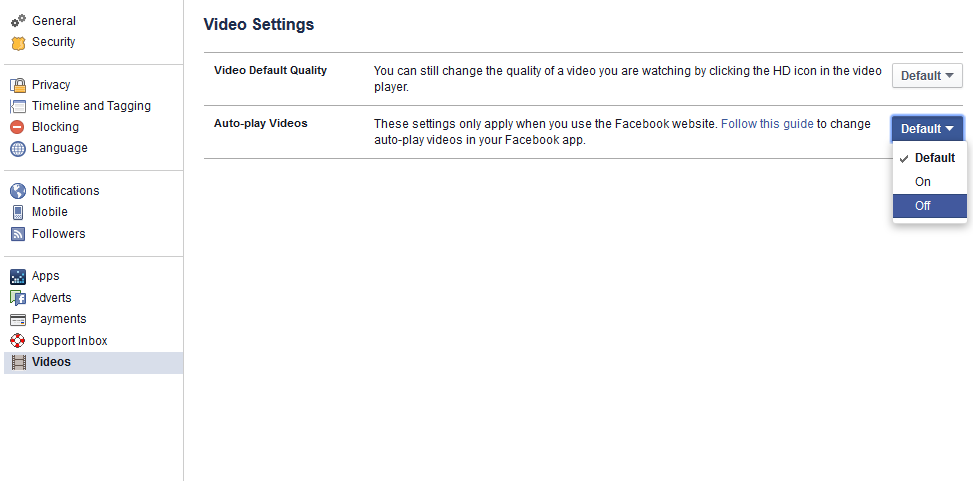
1) Go to Facebook's video settings page when you are logged into your Facebook account.
2) Click the button to the right of Auto-play Videos and choose Off from the drop down menu.
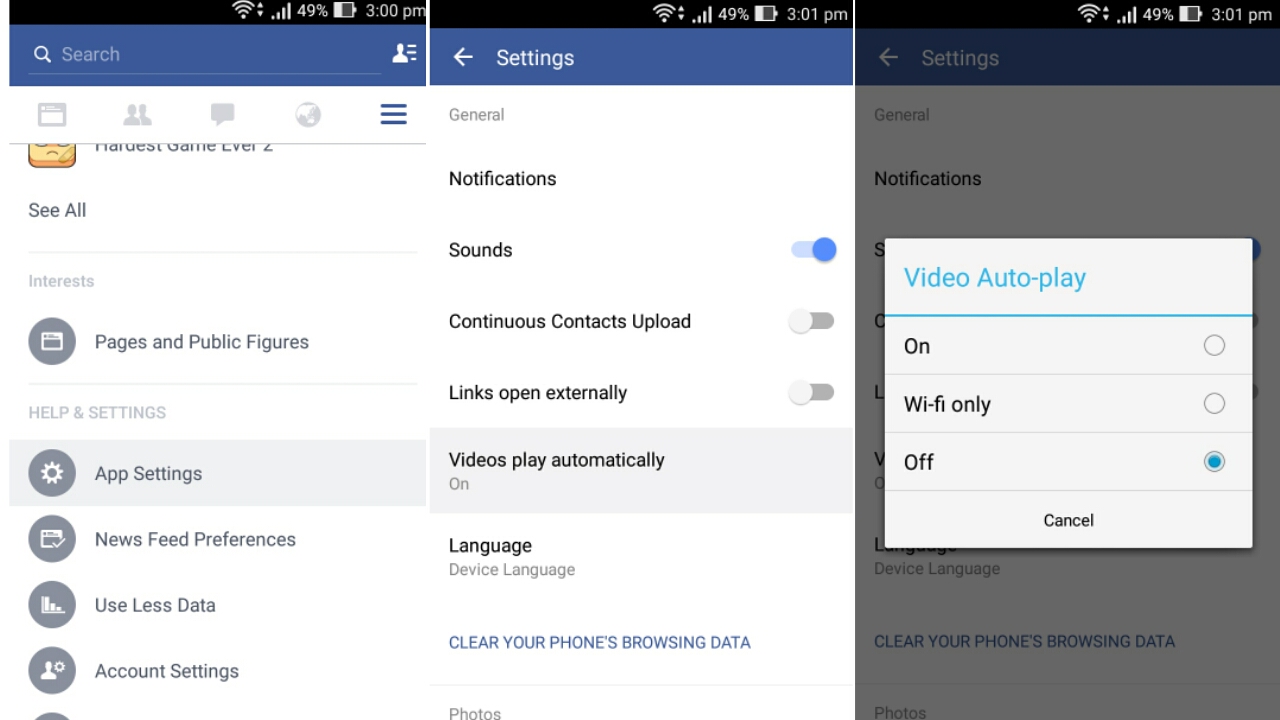
If you are using the Facebook app for Android, use the following steps to stop Facebook videos from autoplaying:
1) Tap the three horizontal lines icon.
2) Scroll down and tap App Settings.
3) Tap Video Auto-play.
4) Tap Off to stop videos from automatically playing, or Wi-fi only if it's okay for videos to autoplay when you are on Wi-Fi.
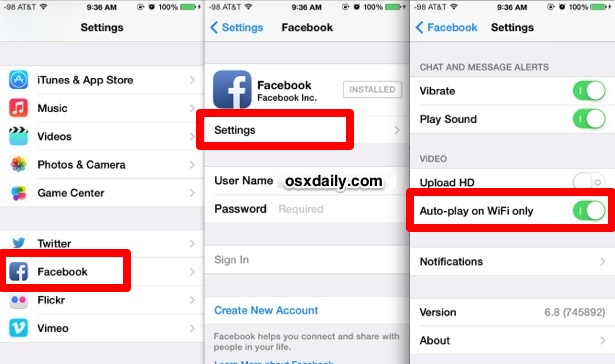
If you are using the Facebook app for iPhone, use the following steps to disable video autoplay:
1) Tap the three horizontal lines icon labelled More near the bottom right corner.
2) Scroll down and tap Settings.
3) Tap Account Settings.
4) Tap Videos and Photos.
5) Tap Auto-play.
6) Tap Never Auto-play Videos to completely stop Facebook videos from automatically playing, or On WiFi Connections Only if you don't mind videos autoplaying when you are on Wi-Fi.
If you are using the Facebook app for iPad, use the following steps to stop videos from automatically playing:
1) Tap the three horizontal lines icon labelled More near the bottom right corner.
2) Scroll down and tap Account Settings.
3) Tap Videos and Photos.
4) Tap Auto-play.
5) Tap Never Auto-play Videos to completely stop Facebook videos from automatically playing, or On WiFi Connections Only if you don't mind videos autoplaying when you are on Wi-Fi.
You have one less annoying thing in your life now that Facebook videos autoplay is disabled. For more tutorials, visit the How To section.
Almost in line with the most recent rumours, Google has now confirmed to launch the new Nexus 5X and Nexus 6P in India on October 13. The search giant has started sending out invites for the event that will take place in Delhi.
According to the gossip online, Google’s Vice President and MD for India and South East Asia, Rajan Anandan, will also be present at the event. Google has decided to introduce Huawei built Nexus 6P and LG-built Nexus 5X in India even before the new iPhones that arrive on Oct 16.
According to the Google Play Store listing, the Nexus 5X will be priced at Rs 31,900 (for 16GB variant) and Rs 35,900 (32GB), while Nexus 6P will be available at Rs 39,999 (32GB) and Rs 42,999 (64GB).
The Nexus 5X features a 5.2-inch screen, 2 GHz octa-core Qualcomm Snapdragon 810 processor, 3GB RAM, 12.3 MP rear and 5MP front camera and a 2,700 mAh battery.
The Nexus 6P features a 5.7-inch screen, 1.8 GHz hexa-core Qualcomm Snapdragon 808 processor, 2GB RAM, 12.3 MP rear and 8MP front camera and a 3,450 mAh battery. Both the devices feature fingerprint sensors and fast charging (with USB Type-C port).
Wanna know more about the phones or the accessories Comment Below! Follow Me on Twitter>>> @iamBhavish And like us on Facebook>>> The Gud1
On October 2, Google completed the process of its transformation into a holding company called Alphabet. With Google having transformed into Alphabet, a new code of conduct for its employees has been posted by the holding company on its website. However, Google’s famous creed “DON'T BE EVIL!” is now absent from Alphabet’s new code of conduct.
Before
After
A report by the Wall Street Journal pointed out that the corporate code of conduct now entreats employees to “do the right thing – follow the law, act honorably, and treat each other with respect.”
According to the report, the Google code, which was written for its 2004 IPO, is much longer and includes rules relating to co-worker relationships, pets, and at-work alcohol consumption, while Alphabet’s sticks to the basics, like avoid conflicts of interest, maintain integrity and obey the law.
Also, the vast majority of Alphabet employees will still be Google employees, part of the core search-and-advertising unit that is the new holding company’s biggest division.
Also according to Reuters: "Google’s class A shares and class C shares will automatically convert into the same number of Alphabet class A shares and class C shares and start trading on the Nasdaq from Monday. The ticker symbols will not change."
Google’s Sidewalk Labs, a company dedicated to coming up with technologies to improve urban city infrastructure such as a free WiFi program, will also be a part of the Alphabet business.
The core businesses will be called Google and operate as a wholly-owned subsidiary of Alphabet. Sundar Pichai will head Google.
Alphabet will be run by Google co-founder Larry Page and each of its businesses will have its own chief executive.
Starting from the company’s fourth quarter in January, Alphabet will have two reporting units – Google and all other Alphabet businesses taken as a whole.
Investors have cheered the move, saying it will give them greater visibility into the financial performance of Google’s highly profitable core businesses.
Alphabet’s businesses will also include connected home products maker Nest, venture capital arm Google Ventures, and Google Capital, which invests in larger tech companies.
Google has announced two new Nexus handsets, as opposed to just a single smartphone as we have seen over the years. As has been widely reported, the two phones are the flagship Nexus 6P and the mid-range Nexus 5X which were unveiled at the Google Nexus event in San Francisco.
Both the phones will be sporting Google’s latest Android 6.0 Marshmallow operating system. Both phones will come with single Nano SIM card slots with support for 4G LTE bands.
The Nexus 5X is priced at $379 (approx Rs 25,000) for the 16GB model and $429 (approx Rs 28,500) for the 32GB model. The flagship Nexus 6P is priced at $499 (approx Rs 33,000), $549 (approx Rs 36,200) and $649 (approx Rs 42,200) for the 32GB, 64GB and 128GB capacity variants respectively. These phones are up for pre-order in the US starting today.
Google Nexus 5X will come with Snapdragon 808, 12.3MP rear camera, 2,700mAh battery
While the India pre-order and launch date for the phones is as yet not known, the Google India Play Store has revealed the prices. The Nexus 6P will be starting from Rs 39,990 for the 32GB variant and the Nexus 5X will be starting from Rs 31,990 for the 16GB variant.
Google India Play Reveals the Prices!
This is the first time that Google has released two Nexus devices. While the Huawei made Nexus 6P will sport a 5.7-inch QuadHD AMOLED display (with a 518ppi pixel density) with Corning Gorilla Glass 4 protection, the LG made Nexus 5X will come with a 5.2-inch full HD display (with a 423pi pixel density) with Corning Gorilla Glass 3 protection. Both phones will come with the Nexus Imprint fingerprint sensor which is located on the rear side of the phone. According to Google, this sensor helps you unlock your phone, use it to purchase apps on the Play Store and the fingerprint recognition happens under 600ms.
Nexus 6P comes with a 5.7-inch display, Snapdragon 810 SoC, 3,450mAh battery
The Nexus 6P will come with Qualcomm Snapdragon 810 chipset which has a 64-bit 2.0GHz octa-core processor with Adreno 430GPU along with 3GB of RAM whereas the Nexus 5X will sport the Qualcomm Snapdragon 808 chipset which has a 64-bit 1.8GHz hexa-core processor with Adreno 418 GPU. While the Nexus 6P will come in 32GB, 64GB and 128GB storage variants; the Nexus 5X will have 16GB and 32GB storage variants. Neither of the Nexus handsets will come with expandable storage options.
On the camera front, Google has added on a 1.55micro pixel size sporting 12.3MP rear camera on both phones, but with the Nexus 6P you get an 8MP front facing camera and with the Nexus 5X you get a 5MP front-facing camera. Both phones are capable of shooting 4K videos and will also feature 120FPS slow-motion video feature, with the Nexus 6P also supporting a 240FPS slow motion video feature. Both phones will support a 30FPS Smart Burst feature which will let you make GIF animations.
Nexus 6P comes with laser detect AF for quick focussing speeds. Also showcasing some image samples in low light
The Nexus 6P comes in an all-metal body design and measures only 7.33mm thick. It will sport a 3,450mAh battery. The Nexus 5X on the other hand will come with a 2,700mAh battery. Both the phones will come with the USB Type-C connector which will support fast charging technology. According to Google, Nexus 6P will give you 7 hours of use with 10mins of charging and Nexus 5X will give you 3.8 hours of use with 10mins of charging.
Google has also added an all new hardware based Android Sensor Hub, which will basically offload all the sensor related activities from the chipset, thereby helping to improve the battery life by as much as 30%. According to Google, the Android Sensor Hub will track “sensor fusion, activity recognition, gesture recognition, movements and low power times.” For instance, Google Nexus phones will be able to light up the display, the moment you pick up the phone by tracking the gyro sensor.
Android Sensor Hub does the following works
Apart from the handsets, Google has also revealed the prices of the accessories that will go with the Nexus 5X as well as the Nexus 6P. The prices of the accessories are shown above. The USB Type-C to Type-C cable will be priced at Rs 1,400; the 15W USB Type-C charger will cost Rs 1,800 and the USB Type-C to Type- A cable and adapters will be priced at Rs 910 each.
Chromecast and Chromecast Audio
Google also took the wraps out on two new streaming devices, Chromecast 2 and Chromecast Audio. The new Chromecast has been completely redesigned and seems to be well received by fans. In addition, the new Chromecast Audio has a similar round disc-shaped design as the new Chromecast too.
Pixel C
Google’s Pixel C is the answer to Apple’s iPad and Microsoft’s Surface. Without an argument, the new device by the company looks great and has also packed in some impressive features.
Wanna know more about the phones or the accessories Comment Below! Follow Me on Twitter>>> @iamBhavish And like us on Facebook>>> The Gud1
Last year, Nvidia had launched its GTX 980, which was followed by the GTX TITAN X which had three times the video memory that was seen on the GTX 980. Targetted more at the high-end gaming and compute/professional audience, the GTX TITAN X costs double that of GTX 980.
Clearly there was a gap between these two top end cards and as expected, Nvidia’s latest card, the GeForce GTX 980Ti (Kind of old now!) tends to fill the gap. It is second only to the TITAN X in terms of feature set.
AMD has launched the Radeon R9 Fury X and Radeon R9 Fury, which are its top of the line cards at the moment. I will be testing them in the near future, if I get a chance. But,for the moment, let us check out the GTX 980Ti.
Firstly lets check out the features it has,
Features
The Nvidia GTX 980Ti is based on the Maxwell architecture and just like the TITAN X, the GTX 980Ti too is based on the GM200 GPU. The GM200 on the 980Ti comes with two of the 24 streaming multiprocessors (seen on the TITAN X) disabled. So you have 22 SMMs giving you 2816 active CUDA cores. The other difference is that the GTX 980Ti comes with 6GB of VRAM which is half of that seen on the TITAN X.
The rest of the specs on the GTX 980Ti are similar to the TITAN X. For instance, both the cards have 8billion transistors, same core clock speed of 1000MHz and boost clock speed of 1075MHz, 384-bit memory bus width and a maximum TDP of 250W.
The GTX 980Ti supports DirectX 12. Also if the Nvidia booth at Computex was any indicator, the GTX 980Ti will also support high end games on VR headsets. Apart from this you have support for Nvidia’s features such as Dynamic Super Resolution (DSR), Multi-frame Anti-aliasing (MFAA), Voxel Global Illumination (VXGI), GameStream, G-sync and so on.
With the DSR activated, the scenes will be rendered at a higher resolution and then will be scaled down to the native resolution of your display. Multi-frame Anti-aliasing (MFAA) is a feature exclusive to high end Nvidia cards, thanks to a hardware feature: programmable AA sample positions. It has been introduced to address the issue faced by graphically demanding games, which get a hit in frame rates when you increase the multi-sampling anti-aliasing (MSAA) to highest levels. The final result can deliver image quality approaching that of 8xAA at roughly the cost of 4xAA, or 4xAA quality at roughly the cost of 2xAA. With Voxel Global Illumination (VXGI), Nvidia allows a real time global illumination engine which assures realistic reflections.
Build and Design
Nvidia flagship cards have kind of acquired a uniform design language. The GTX 980Ti like the GTX 980, GTX 780Ti, GTX TITAN and to an extent the GTX 690 before it, has stuck to the similar gray coloured design with slight variations. On a first glance, the designs look identical – the 65mm radial fan is the same, the flourescent green GeForce logo atop the card is the same, the gray/black sheath is the same.
The card measures 10.5-inches in length. Under the gray metallic shroud, you have a black-coloured heat-sink though. Under the heat-sink, you have three heat-pipes that transfer heat from the GPU to the heat-sink. This is a departure from the vapour chambers used in the GTX 780Ti and GTX Titan.
The GTX 980Ti adds in a backplate to the card to protect the PCB on the rear side. In addition to this, Nvidia also allows you to unscrew the top of the back plate just behind the PCIe power ports. On the display front, you have 3x DisplayPort 1.2, 1x HDMI 2.0 port and 1x DVI port. As is evident, Nvidia is pushing people to adopt the 4K displays for their systems having the GTX 900 series cards. The HDMI 2.0 port also supports 4K at 60Hz. It requires just one 6-pin and one 8-pin PCIe power connectors.
Performance
3DMark 11
3DMark is a computer benchmarking tool created and developed by Futuremark Corporation to determine the performance of a computer’s 3D graphic rendering and CPU workload processing capabilities. The latest version makes extensive use of all the new features in DirectX 11, including tessellation, compute shaders and multi-threading. I used the “Performance” preset for this benchmark.
The Witcher 3: Wild Hunt
The Witcher 3: Wild Hunt is an open-world action role-playing game. The story revolves around the protagonist Geralt of Rivia who is on a journey through the lands of the Northern Kingdoms. It is based on the REDengine 3 game engine which is meant for non-linear RPGs. Since the game does not have its in-built benchmark we played a set saved game which involved couple of action scenes and riding on horseback through various terrains including through water. I used FRAPs to keep track of the frame rates. The graphics section also has a separate post processing section. I played it using the Ultra and Medium settings.
Temperatures
I noted the temperature of all the participating cards at idle and load states. The fan speeds were kept on auto. I also noted maximum load temperatures after running benchmarks such as FurMark at 1080p preset, 3D Mark 11, Battlefield 3 and Metro: Last Light and taking an average.
Power Consumption
I used an energy monitoring device(which I have no idea about!) to measure the power consumed by the total rig with the graphics cards on them. The Cooler Master 800W PSU was plugged into the power meter which gave out the power consumed in Watts on the display. After powering on the system I let it stay unused for a good five minutes to get the idle power reading and then ran three instances of FurMark 1080p preset to get the maximum load power.
Verdict and Price in India
The Nvidia GeForce GTX 980Ti comes out tops in most tests as far as single GPU cards go. Of course the price point of Rs 55,999 slots this card in the high end segment. Ideally those who already have or are planning to get a 4K monitor to play games at all settings maxed out, is the audience Nvidia is looking at. If you have a 1080p display, it is pointless to go for this card as it will not do justice to the performance the GTX 980Ti can offer.
The load power and load temperature readings aren’t the best of the lot, but with a beast like the GTX 980Ti which gives a superior performance than other competing cards, that should be expected. The 6GB VRAM on the GTX 980Ti is more than enough to handle the taxing games. I will be trying to test the AMD Fury series cards soon to see how they perform against this card which is almost as good as the flagship TITAN X.
Indian Prime Minister Narendra Modi is on the last leg of his visit to the US. Over the past couple of days, Modi has managed to speak to a host of Fortune 500 CEOs. Among the prominent announcements from Modi’s Silicon Valley visit are:
Google announces plans to offer free Wi-Fi at 500 stations
According to a recent report released by the United Nations Broadband Commission titled, ‘The State of Broadband’ report prior to the Broadband Commission for Sustainable Development said that India slipped in global rankings on broadband penetration.
While many may argue that it is the Government’s responsibility to provide an effective and affordable access to broadband internet, the fact remains that India is now behind countries such as Syria and Sudan in terms of internet penetration.
During PM Modi’s visit to the Google campus during the Code for India hackathon 2015, Google CEO Sundar Pichai announced that Google would be partnering with Indian Railways to provide high-speed broadband internet connectivity at 500 Indian railway stations. Pichai stressed that these connections would enable streaming of high definition video content, stressing that they would not just enable connectivity but enables consumption of high bandwidth video.
Microsoft Broadband connectivity to 5 lakh villages
After Google, it was Microsoft’s turn to sweeten the deal. While Google focussed on high speed connectivity, Microsoft CEO Satya Nadella announced that Microsoft will partner with the Indian government to bring low-cost internet connectivity to 5,00,000 Indian villages.
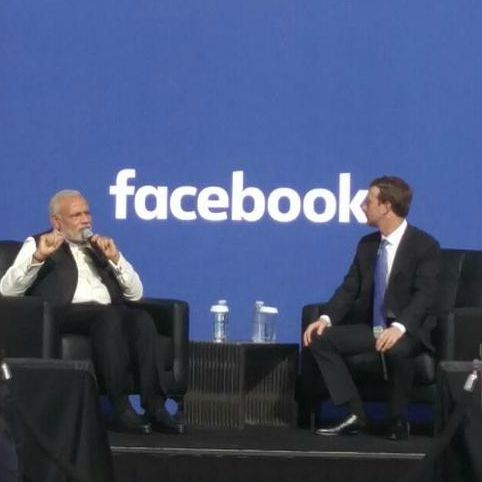
During the townhall at the Facebook HQ with CEO Mark Zuckerberg, PM Modi responded to a query on how effective the Make in India campaign would be and the ease of changing the course of things. He gave the anecdote of a scooter being driven and how easy it is to divert its course. Modi added that in the case of train, it take time to steer it in a new direction. This was in reference to the scale of India. At the Facebook townhall, Modi highlighted that India has a unique challenge of over 600000 villages.
The announcement by Microsoft couldn’t have come at a better time than when the Digital India initiative has been proposed to the world.
Microsoft data centres in India next week
In his announcement, Nadella added, “A key part of both Make in India and Digital India, bringing world class infrastructure into India, respecting India’s digital security, sovereignty and privacy is a key milestone for us.”
This would enable Microsoft to offer high speed services, cloud hosting, as well as enable scalability to small business, young enterpreneurs and large corporations in India. Interestingly, in March 2010, Microsoft launched the Azure Platform in India.
However, earlier this year, in March 2015, Microsoft had launched the cloud program for India. The plan to announce data centres in India is quite likely a natural extension to an existing go to market plan for Microsoft. However, the announcement during Modi’s visit to the US has only increased global interest in the development.
Google type in 10 Indian languages including Gujarati
After announcing high-speed internet, Google also announced that users in India would now be able to type in 10 Indian languages. In an official blog post, Google CEO Sundar Pichai said, “To help make web content more useful for Indians, many of whom don’t speak English, we launched the Indian Language Internet Alliance last year to foster more local language content, and have built greater local language support into our products—including Hindi Voice Search, an improved Hindi keyboard and support for seven Indian languages with the latest versions of Android.”
Similar to the case of Microsoft, the announcement by Google invoked significant national interest. Last year, Google had announced the Indian Languages Internet Alliance to work with local languages. In 2014, Google’s Rajan Anandan announced “Google’s Anandan said that the plan was to bring the features to at least the top eight Indian languages within the next 18 months, which would include Bengali, Marathi, Tamil, Malayalam, etc.”
Qualcomm $150 million fund for start-ups
In another announcement that aligns with PM Modi’s plans for the SME and start-up segment, Qualcomm announced support for the Digital India and the Make in India initiative by launching a $150 million venture fund for startups.
According to Qualcomm’s executive chairman Dr Paul Jacobs, the main objective of this fund is to “Fuel innovation and foster promising Indian start ups who are contributing to the mobile and ‘internet of everything’ ecosystem and provide start ups with financial, marketing, technology and business support to help propel them forward in the competitive Indian market.”
Apple to manufacture in India?
In June this year, there were reports of Chinese manufacturer Foxconn planning to set up an iPhone manufacturing plant in India. During the meeting between PM Narendra Modi and Apple CEO Tim Cook, the possibility of manufacturing in India was discussed.
External Affairs Ministry spokesperson Vikas Swarup quoted Apple CEO Tim Cook as saying during the interaction, “We have a unique tie with India. Our founder Steve Jobs went to India for inspiration.”
Facebook embraces Digital India
During the townhall at Facebook HQ, CEO Mark Zuckerberg announced that before Facebook made it big, and before things worked well, they hit a rough patch.
Zuckerberg said, “Early on in our history when things weren’t really going well – we had hit a tough patch and a lot of people wanted to buy Facebook – I went and I met with Steve Jobs and he said that to reconnect with what I believed was the mission of the company, I should go visit this temple in India that he had gone to early in the evolution of Apple, when he was thinking about what he wanted his vision of the future to be.”
Zuckerberg did heed the advice. And spent a month visiting India. He added that seeing the way people connected in India made him believe that the world would be a better place if everyone had a stronger ability to connect. Zuckerberg changed his profile picture to support the ‘Digital India’ initiative.
Sundar Pichai, CEO of technology giant Google, today said India has long been an exporter of talent to technology companies, but is now undergoing its own revolution that will have great benefits for the 1.2 billion people in the country.
Welcoming Prime Minister Narendra Modi to the Silicon Valley, the India-born CEO said there is tremendous excitement for his visit among all Googlers and the entire Indian community.
“The bond between India and the Silicon Valley is strong. India has long been an exporter of talent to tech companies. The products built by Indian graduates from IIT and other institutions have helped revolutionise the world. But it is India that’s now undergoing its own revolution,” he said in a YouTube video.
He saw great benefits for everyone in the country as “many people will come online for the first time, especially those in rural areas and Indic language speakers”.
It will also help girls learn new skills and have successful careers, power education of the next generation and help businesses of all sizes to find new customers, Pichai said.
“We’re looking forward to your remarks at the SAP Centre in San Jose, and also when you come to Google… We hope your visit will energise people in the Valley, excite Indians all across the country, and renew and strengthen our partnership,” he said.
During his US visit, Modi is also scheduled to meet Facebook CEO Mark Zuckerberg and address a townhall question and answer session on September 27 at the company’s headquarters in California. He is expected to meet Apple CEO Tim Cook and electric carmaker Tesla’s CEO Elon Musk, among others.
Modi is addressing the India-US Startup Konnect and share his vision on ‘Start up India, Stand up India’ to be hosted by Indian IT industry body Nasscom, TiE Silicon Valley, and IIM Ahmedabad’s CIIE India.
In the next few years, about 50 million women and 20 million small businesses are expected to get online for the first time, he said.
“Prime Minister Modi’s Digital India vision is central to this revolution. It focuses on connecting the 1.2 billion people in India. It has received tremendous support in India and in Silicon Valley,” Pichai said.
Highlighting the role played by Google, Pichai said the company as well as many others around the world are passionate about playing their part.
“Some of our initiatives include making our products work on low bandwidth and even offline, making the Web accessible in Indic language, providing low-cost Chromebooks in Indian schools, investing in core infrastructure and affordable smartphone with Android One,” he said.
Google has sent out an invitation for an event in San Francisco on September 29. The invite features the newly designed logo along with the tagline, ‘Join us for some tasty new treats and much s’more.’
The company is rumoured to unveil the next Nexus phones, which are said to be manufactured by Huawei and LG during this event. In addition, Google might also unveil the second-gen Chromecast streaming device. This platform will give Google a chance to showcase the final version of Android Marshmallow as well.
The event could also potentially mark Sundar Pichai’s first big event since the reorganisation. This will be the first time that Huawei will manufacture a smartphone for Google, while for LG, this would be the third time that the company will make a Nexus smartphone for Google, following the Nexus 4 and Nexus 5 smartphones. In addition, these phones might the first to run Android 6.0, nicknamed Marshmallow.
The Huawei Nexus smartphone is rumoured to sport a 5.7-inch QHD screen translating to 2560 x 1440 pixels, a metal body, Snapdragon 820 SoC and a fingerprint reader. Going by some previous reports, the Huawei-built Nexus is codenamed Bullhead and will come with a 5.7-inch display.
Recently, details of the other Nexus smartphone, made by LG, were leaked. According to uSwitch, the new smartphone by LG will offer a rear fingerprint scanner along with a metal frame and plastic rear. In addition, the front panel will showoff dual-stereo speakers. Other rumoured specifications include a 3D camera along with a Qualcomm Snapdragon 810 chipset. The report also suggests that the screen will be offered in 5.2 inches and will be 146.9mm high, 72.9mm wide and 8mm thick.
On the camera front, it is expected to come with a 12.3MP sensor and a front-facing 5MP sensor. The device will be made available in 16GB and 32GB models. The report also suggests type C USB port and a 2700mAh battery.
Apart from the proposed Huawei and LG made Nexus devices, another product is also expected to release – the second generation Chromecast.
According to a report in 9to5Google, a brand new Chromecast hardware is set for debut at the Google event. In terms of design, the new hardware will be completely different from the older Chromecast. It will no longer be a dongle form factor.
Apart from a different design, the new generation Chromecast is expected to come with features such as support for Wi-fi 802.11ac as opposed to previous generation’s support for Wi-fi 802.11n. There will also be support for ‘content feeds’ which could probably be your social media feeds or image feeds, which can play when your Chromecast is in the screensaver mode.
Users will be able to see the live event on the 29th at 9AM PST, and will be able to catch it on Google’s YouTube channel.