Showing posts with label galapagos. Show all posts

Monday, August 18, 2014

Thin bezels are thin. Heavy bulkware is heavy.


An article by Ishikawa Tsutsumu discussing the effects of Docomo releasing the iPhone late last year made brief mention of a Sharp Android phone for both Softbank and Sprint.
Softbank is hoping that Sharp’s expertise in LCD technology will help Sprint to differentiate itself from its competitors in the US market. The company plans to develop a single Android device for both countries.
Based on that, we knew this phone's defining characteristic would be it's screen.

While Mr. Son knows first hand what an exclusive, must-have phone can do for a carrier, he also knows that phones with just as thin or thinner bezels will be released by every maker soon. In a country with the population spread thinly over a large area, network coverage and quality (as opposed to phones) become much more important factors when choosing a carrier. Unlike Japan, where network coverage – and congestion – is pretty much equal in all major metropolitan areas, there are absolutely stunning differences between the four major US carriers across even highly populated areas. (I used Sprint for a week in San Francisco, and it was the most frustrating mobile experience in recent memory.)

It seems the US-based tech sphere is enamored with this phone, but I wonder how they'll feel after experiencing the quirks of a galasuma. In particular, domestic makers have been pretty bad at removing expected functionality. Some American consumers could be in for a shock with their first Japanese smartphone.

Having said that, however, Sharp is one of the domestic makers to survive the initial release of Android, which means that their firmware didn't suck as bad as NEC and Panasonic et al's. That one of our contributors loves Sharp phones also shows that Sharp is doing something right.

Specs

Preorders started today for the Aquos Crystal, and it goes on sale at the end of this month. Really, the only thing this phone has going for it is the screen. No one seg, no osaifu-keitai, and NO WATER RESISTANCE. Wut?! I thought the whole "aquos" brand was marketed around waterproofing. Silly me, I forget that brand predates mobile.

The Crystal X is the much better phone, but it still LACKS WATER RESISTANCE. It does have one-seg, osaifu-keitai, and VoLTE, though, so if I were to opt for one, it would be the Crystal X. However, it won't be available until the end of the year, perhaps even next year (12月以降), at which point I bet we'll already see similar thin bezels from other makers.

Thursday, July 10, 2014

Paying for things in Korean Won cash using a Japanese Galapágos NFC phone

Android mobile cashbee app icon
mobile cashBee for Android; not just an app for Korean carriers and phones
In the previous posts, I covered how to use your Japanese phone in lieu of traditional "plastic" when traveling overseas outside of Japan. Using credit cards are convenient, especially for overseas travel where a lot of credit cards have mechanisms for after-the-fact disputes and fraud protection. However, depending on your card, you can also be charged fees for non-domestic transactions, and the just-in-time exchange rate between the card's currency and the local currency may not always be in your favor.

This begs the question: are there any countries like Japan where one can pay for things using pre-loaded cash (other than Japanese Yen) stored inside the Japanese phone's NFC?

As a matter of fact, yes: the Republic of Korea.
Il-76, Il-62 & Tu-204
No, not this Korea.
As any tourist or resident in Japan knows, having a NFC card or phone to get around the city by subway is super convenient, sparing you the details of having to understand fare charts for complicated transportation systems. The card enables you to slip in and out of the stations without worrying about whether you've underpaid or overpaid for your fare; you can focus on catching the correct train at the correct time. Additionally, the touch-and-go payment allows you to quickly grab a quick snack at a nearby kiosk without having to fumble with currency you're not familiar with.

The best part is: the technology is free with no fees or a required signup *. If you bought a card in Korea, you'd have to pay a deposit fee for the card (which is refunded when you return the card).

As South Korea is one of the closest countries to Japan, it is one of the easiest (and cheapest) international destinations to visit. Before you visit, it'd probably be wise to set this app up if your phone specifications qualify.

* Of course, using the app (rather than a charging station) to reload your NFC with more ROK won causes packets to be sent, and if you're overseas, depending on your broadband or Wi-Fi access (the app, unlike iD, works with either), might be significant. Additionally, your credit card company or bank, not the app, might card you a transaction fee for moving money into the NFC chip.

Competing Technologies in South Korea


Like Japan's pre-loaded cash options (Edy, nanaco, WAON, Suica), South Korea also has a variety of NFC solutions for paying via cash:
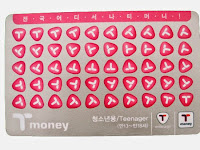
many cards are branded
t-money card (티머니 카드 {timeoni kadeu})
In the past, t-money was one of the first major NFC payment cards (introduced around the year 2000) and it is the biggest and still the most popular: primarily used in Seoul. If you were outside of Seoul, you used cashBee. Similar to Kantō (East Japan)'s Suica/Pasmo card vs the cards in Kansai (Western Japan). Nowadays, there's not as much difference geographically as to whether a card is better or more accepted. A big drawback for t-money, from a foreign user's point-of-view, is the proprietary solutions for mobile use: In order for a South Korean resident to use t-money with his phone, they must apply for a non-standard (not a NFC Type A/B) SIM to insert into their phone.
mobile cashBee (모바일 캐시비 {mobail kaesibi})
In the past, cashBee was more predominant outside of Seoul, but this is no longer the case. cashBee is rapidly catching up in popularity and places where it is accepted thanks to its major corporate backing; cashBee is issued my the big Korean corporation Lotte, so much like how anything associated with JR East (such as atre malls) will accept Suica, anything associated with Lotte in Korea will probably accept cashBee. Relatively new, cashBee is an evolution of the Korean NFC system "Mybi", which began in 2000, and all the systems that were compatible with it such as KB Free Pass and KTX Family Cards. The old eB cards (the "B" is where the "Bee" in cashBee came from), UPass, and Mybi were acquired and evolved into cashBee in 2010. The Mybi family of cards is still accepted in places, but the technology has been deprecated.

These are the two major payment systems in use today. Much like Japan, bigger companies are acquiring and re-branding other companies and technology all the time, so there are lots of other minor cards and special limited edition cards which are compatible with the two major ones listed here. And there are other, older systems which have fallen into disuse. Talking about all of them here, though, is outside of the scope of this blog and article. As a tourist, all you need to know is that the above two comprise most of the major offerings in 2014.

How to set up your phone to use it

cashBee, although very similar to Japanese preloaded cash systems used on FeliCa only, is a NFC Type A/B system. This means the same hardware/software requirements are needed that you would need for paying for things overseas with Visa/MasterCard payWave/PayPass:

Desired requirements for maximum usefulness:
  • A Japanese phone with hybrid FeliCa/NFC hardware.
  • A USIM that supports NFC Type A/B
Note that you can still install and use the cashBee app even if you do not meet the above requirements. However, the app will only work in "coupon mode", in that it will show you coupons you can use in Korea at participating cashBee stores, but you will not be able to purchase anything using your phone.

And even if you don't have a credit card, you can still "charge" your cashBee (provided you've launched the app and it has installed itself in the NFC area of your USIM) at vending machine like "charging stations" (or at convenience stores) throughout major cities in South Korea.

Both the NTT version and the KDDI version allow charging of the phone with Korean Won via credit card. The credit card will be billed in Japanese Yen.

Softbank's dog mascot urinating at a press conference
Softbank's mascot, otōsan, can't wait.

Softbank

There is a version of cashBee for both docomo and KDDI/au. The software is identical except that currently the au version is the only one that supports loading the cashBee via Japanese bank 振り込み {furikomi} (domestic wire transfer).

A Softbank version of the app was scheduled to be released on June 30, 2014, but it has been delayed. As of July 10, 2014, it has not yet been released yet.

iPhone and other unsupported app platforms
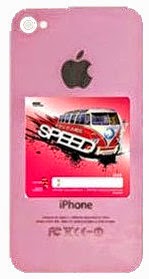
pink iPhone 5c with a NFC sticker on the back
The speed of Steve Jobs,
spinning in his grave
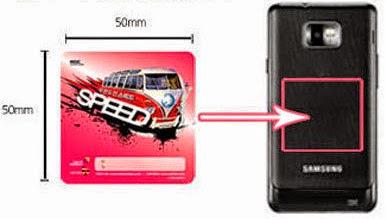
25cm² NFC adhesive sticker
You have a choice of designs to foul your phone
In addition to key chains and other non-traditional (meaning non-rectangular plastic credit card) shapes, cashBee and other forms of e-Money in Korea are available in adhesive sticker form, which you can attach to the back of your phone and pretend you have NFC capability.

You may have seen Japanese iPhone users do something similar to this by buying a case for their iPhone (so you can't really tell it's an iPhone anymore) and inserting their Japan mass transit IC card in between the back of the phone and the case that covers and protects the back. In fact, many iPhone "bumper" cases are sold which feature special slots where you can insert this card and pretend you have an Android phone.

Don't put one of these stickers on a phone that already has NFC and/or FeliCa: by design, NFC and FeliCa won't work in combination with other cards or stickers at the same time. They cancel each other out.


Where is cashBee accepted?
cashBee logo
Newer but heavily backed
T-Money logo
Older but more established
T-Money is the older, and thus more widely accepted, form of e-Money in Korea. However, cashBee is catching up extremely rapidly. While it's unlikely you'll be able to use cashBee at old fashioned mom & pop restaurants or shops or very high end places, most of the places in major urban areas that offer common consumer day-to-day goods and services offer support for at least one -- and often more than one -- form of electronic cash payment.

Public transportation (subway and buses)

The NTT/docomo version of the cashBee application got the ability to touch & go with the subway and bus systems this summer (2014).

The KDDI/au version of the cashBee will get the ability to tough & go with the subway and bus systems this Autumn (2014).

Like most subway and train systems in Japan, most of the subways in Korea charge based on the the distance you travel, and buses charge a flat fee.

Taxis

Gangnam Style
Probably has a cashBee in his pocket.
Taxis in the following areas of Korea currently take NFC payments:
  • All of 서울 {Seoul}, including:
    • 明洞/명동 {Myeong-dong}
    • 江南/강남 {Gang-nam}
  • 釜山/부산 {Busan}
  • 済州/제주 {Jeju}

Additionally, the taxi companies in these smaller areas also currently accept cashBee:
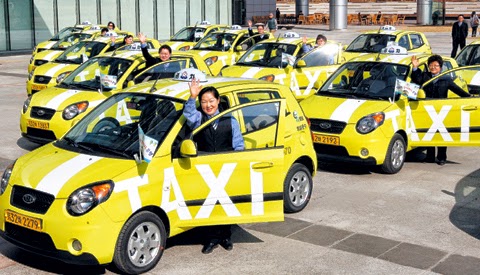
Korean Taxis
"Deluxe" taxis are black with a yellow sign on top.
  • 京畿/경기 {Gyeong-gi}
  • 仁川/인천 {In-cheon}
  • 江原/강원 {Gang-won}
  • 忠南/충남 {Chung-nam}
  • 蔚山/울산 {Ul-san}
  • 慶北/경북 {Gyeong-buk}
  • 慶南/경남 {Gyeong-nam}
  • 光州/광주 {Gwang-ju}

However, just like in Japan there is an occasional cab that does not accept credit cards or FeliCa payments, there are hired drivers in Korea that do not take anything other than physical cash. So be sure to check before you start the fare.

Convenience Stores

7-Eleven vs. MINISTOP
Residents of Japan are probably familiar with
  • 7-Eleven
  • MINISTOP
which are ubiquitous in Japan. They are also all over Japan. In addition to making purchases, you can also charge (add money) to your NFC card or phone with cash via the register without using a unmanned charging station.

In addition to the two above convenience stores, cashBee is accepted in at least the following "combini":
  • Buy the Way (a Lotte 7-Eleven franchise)
  • CU
  • GS25
  • StoryWay

Fast Food & Family Restaurants
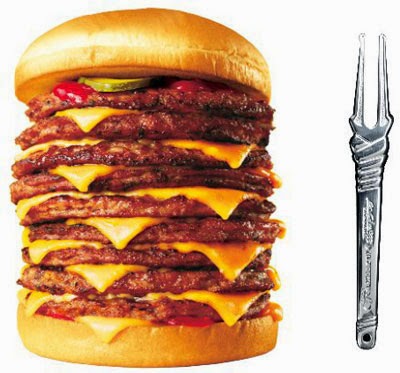

『Q段チーズバーガー』
The Lotteria Japan promotional 9 {Q}-level cheeseburger
Residents of Japan are probably familiar with:

  • Lotteria: a fast food burger joint by Korean über conglomerate Lotte)
  • Baskin Robbins: better known by its official name in Japan as 『サーティワン』 {"sāti wan"} (31)
  • Krispy Kreme Doughnuts: seems to do better in Asia than its native North Carolina
  • Dunkin' Donuts: the smaller Massachusetts based rival to the more popular (in Japan) known affectionately by its Japanese nickname of ミスド {misudo} (Mister Donut).
and Americans are probably familiar with:
In addition to the above, cashBee is also accepted at:

Lotte affiliated Shopping (Department Stores, etc.)

Lotte Department Store (Myeongdong)

Entertainment (movie theaters, etc)

Sajik Baseball Stadium

Other (Vending Machines, Universities, Toll Bridges & Tunnels)
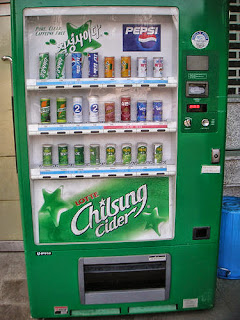
Lotte "Seven Star" Vending Machine
Chilsung Cider tastes like Sprite/7-Up.

"Recharging" your cashBee

MasterCard and Visa logos
No JCB or AMEX yet.
The convenient part of the Japanese app is it's ability to load money in by billing your credit card. Currently, only MasterCard and Visa are accepted.

No fees are assessed on the cashBee side; whether your card charges you a fee or not depends on your card.

You will be billed in Japanese yen based on standard exchange rates for the day between Korean Won and Japanese Yen.
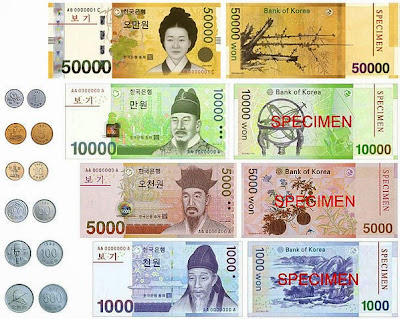
South Korean Won bills and coins.
Money used on the other side of the Sea of Japan ("East Sea")
The amounts you can choose to load on the NFC UIM Card are:

  • ₩10,000
  • ₩20,000
  • ₩30,000
  • ₩40,000
  • ₩50,000
  • ₩100,000
  • ₩300,000
  • ₩500,000
The credit card credentials are not saved, so your will need to enter the card number, cardholder name, expiration date, and CVC number every time.

If you don't want to charge your NFC UIM by using the internet (perhaps because you are already overseas your international roaming or Wi-Fi is too expensive or limited), you can find a convenience store or charging station machine and charge it with (Korean Won) cash.

Direct Bank Transfer with KDDI/au

au by KDDI
Something au does that DCM can't
Transferring money into your UIM Card via a bank transfer is only slightly more complicated than transferring via credit card; both transactions are instantaneous. Depending on the terms of your credit card or bank, one method may be more advantageous than the other (depending on limits, fees, etc.)

Currently, only three "net banks" (banks without physical branch locations and tellers and vaults) are supported:

Changing phones and limitations

From the application, the minimum amount you can charge (with Korean cash) your NFC UIM with is ₩10,000. The maximum is ₩500,000.

Similar to how most 電子マネー {denshi manē} (e-Money) systems in Japan limit you to a maximum of ¥50,000 per system (for sanity and safety and fraud concerns), cashBee limits you to a maximum charge of ₩500,000.

Money in the UIM card has an expiration date of 5 years from the last use or charge. If not used or charged after five years, the loaded money is voided and lost.

One point Korean/Japanese/English language lesson

『영어완전정복』 "Yeongeo wanjeonjeongbok"
A great 2003 romcom about
South Korea's English complex
In Japanese, the foreign loanword 『チャージ』 {"chāji"} ("charge") is usually used with the nuance of loading money onto a contact-less card or FeliCa/NFC phone; a fancy more specific loanword for the proper/generic Japanese word 入金 {nyūkin} (insert/receive funds/payment).

However, in Korean, the same imported English loanword has the nuance/meaning of "charging [the battery of a phone etc]".

This may lead to a misunderstanding if you ask to "top up/off" (British English) or "load your prepaid card" (American English) your cashBee at a convenience store in South Korea, as charging the batteries of mobile devices actually is a service they provide at many convenience stores in Korea.

It shouldn't be too hard to get your point across by saying "cashBee" and pointing to cash that you want put on your device, though.

Here's how to say

"Please reload 5000 won onto my mobile cashBee."
모바일{mo-ba-il} 캐시비에 {kae-si-bi-e} 5000원 {o-cheo-nwon} 충전해 {chung-jeon-hae} 주세요 {ju-se-yo}.

Sunday, July 6, 2014

Part 2: How to pay for things overseas using your Galapágos Android NFC and PayWave

This Verifone terminal does them all
In the previous article I talked about how to pay for things outside of Japan using a Japanese phone and a NFC terminal. In particular, using iD required at least two things:
  1. a docomo phone (since the iD service, while available for a variety of plastic credit cards, is only currently offered on docomo as of July 2014)
  2. a Japanese MasterCard that supports PayPass
But what if you have a Visa card? What if you have your phone/carrier isn't docomo? There are options.

Minimum Requirements for any overseas NFC Use


First of all, you will still need the bare hw/sw requirements that were mentioned in more detail in the previous post:
  • A docomo/au/Softbank phone that supports NFC types A/B/F (NFC Type F is the same thing as "FeliCa")
  • A USIM that supports NFC Type A/B. If you bought your phone recently your phone probably already has one of these and you don't need to talk to your carrier for an upgrade.
  • Your NFC R/W P2P needs to be "off" when using payment systems, which expect the NFC to be in client/master mode (the phone is the "client," the Point-of-Sale terminal is the "master")

Bank Provided Apps for Japanese Galapágos Phones

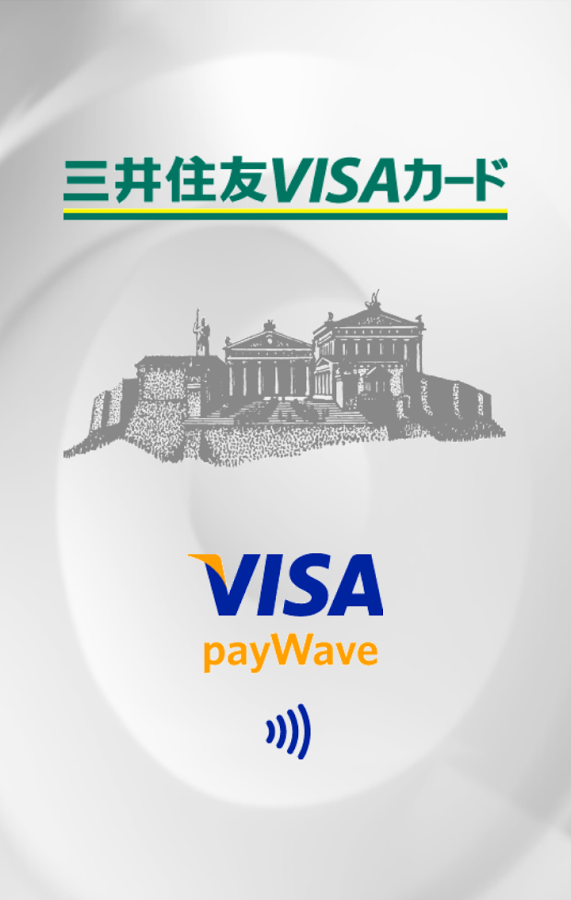
Finally, you will need a bank that supports NFC credit cards through its own app (or one that it partners with). Currently, there are two credit card companies that offer overseas credit card ability: Sumitomo-Mitsui Visa (PayWave) and Orico Visa (PayWave) & MasterCard (PayPass). Orico was the first in Japan to offer Visa's payWave.

三井住友VISAカード VISA payWave
Sumitomo-Mitsui's Visa PayWave
Orico VISA payWave / MasterCard PayPass
Orico's payWave/PayPass


These applications can be installed on compatible docomo, au, and Softbank phones. If you have a Orico MasterCard, you can choose to use the Orico app to set it up, or choose the iD app.

Just like the instructions in the previous post, simply possessing the correct card and a working app/phone is not enough; you need to contact your credit card company (either at application or afterwards) and tell them to you wish to use this functionality, and they will send you a one-time use "access code" and password to activate it.

As PayPass and PayWave services are still very new in Japan, it is likely that additional banks and cards will offer this service in the future.

VISA payWave accepted mark
Visa payWave (& most probably MasterCard payPass;
maybe American Express expresspay/Discover zip OK

Card Compatibility at the POS Terminal

VISA payWave can be used almost anywhere MasterCard PayPass is accepted, especially in the United States. If you see the payWave mark, you can almost always use PayPass/MasterCard as well, the same way how almosty all stores that accept Visa also accept MasterCard. There are some rare exceptions.

American Express' NFC service is called "expresspay". It too can be used where the "wave" mark is present and the merchant accepts it.

Currently no American Express cards issued by Japanese banks support expresspay (that will probably change in the future).

Discover Card's NFC system is called "zip". While Discover Card is not issued in Japan, Japanese Diner's Club and JCB cards can be used wherever Discover is accepted and vice-versa (normally there will be a small Discover logo on the back of these Japanese cards).

NFC Credit Card Android Apps: set it up then forget/delete it


One does not simply "Set It And Forget It"
A dissenting opinion
A note about all the Android apps: The iD App, Orico NFC Service, and Sumitomo-Mitsui Card Visa payWave apps do not have to be on your phone at all time to use NFC. These apps are used to "set up and program" the data block(s) on the UIM card, as well as query it (find out the card number, name, expiration date, etc) stored on it.

Deleting the Android app that initialized the NFC type A/B/F record does not delete the corresponding NFC data.

However, for some FeliCa/NFC apps, deleting the app — or doing a full reset of the phone, wiping user data — then re-installing may cause the new instance(s) of the app to not recognize or locate the old data. This depends on how the app is designed. Poor software design, yes. But caveat emptor.

Don't forget to assess your personal balance between convenience and risk and set your phone's security (and your NFC's security) appropriately.

Non NFC Credit Card Android apps: useful for balance, transaction history, etc.

One app to set it (NFC), another app to check it (cloud).
On the other hand, keeping the app around, especially for NFC apps that have a balance on them (pre-loaded cash or points), is handy so you can check to see how much money (often through custom Android widgets on your home screen) you have left and to top off the balance with more money. You can do this at specialized terminals and ATMs throughout the country too. As a credit card has no "balance" on the chip, these apps don't have as much value. There may be a side function (or a completely separate app for your credit card, or a mobile web site) that checks how much credit you have remaining. For example, Sumitomo-Mitsui has the Vpass app to check its credit card status and transaction details, American Express Japan has an app to check its Japan based AMEX cards, and Rakuten Card has an app to check its cards' balances and activity.

Friday, July 4, 2014

How to pay for things overseas using your Galapágos docomo Android NFC and PayPass

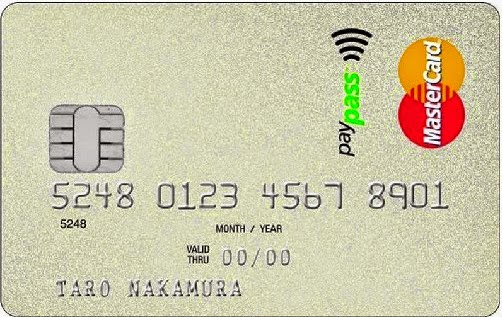
PayPass™ point-of-sale terminal
Japan adopting tech (NFC) that was originally adopted from Japan (FeliCa)
In the Japanese 電子マネー {denshi manē} (e-cash) world, there are currently six main FeliCa (a Japan-based near-field communication system) based systems for paying for goods at stores and restaurants with Japanese yen using your Japanese mobile phone's おサイフケータイ {osaifu kētai} (Osaifu-Keitai "mobile wallet") app:
#1. iD [credit]
Affiliated with NTT's docomo, it ties primarily to Visa/MasterCard®, and docomo's DCMX credit service. (with some exceptions depending on the issuing bank). iD is not a smartphone-only technology; it can (and often is) embedded in Japanese credit cards standalone.
QUICPay
iD's credit-based competitor
#2. QUICPay [credit]
It ties primarily to JCB and AMEX credit/charge cards (with some exceptions depending on the issuing bank). It is a standalone technology that links existing credit cards to your phone; there are no credit cards that have "QUICPay" NFC chips in them.
#3. WAON [pre-loaded cash]
It is affiliated with JAL for miles; preferred payment system for ÆON (イオン {Ion}) owned businesses.
楽天Edy
logo after Bitwallet K.K. acquisition
#4. Rakuten Edy [pre-loaded cash]
It's affiliated with ANA for miles, and also Rakuten Super Points, Ponta (Lawson, KFC, …), Edy de COIN (GREE), T-POINT, Yodobashi Gold Points, EPOS Card, Belle Maison Points, Bic Points, NEXCO, Edy de Matsumoto Points, EDION Points; you can also pay with cash in your smartphone's Edy for goods over the internet — via smartphone or personal computer.
#5. nanaco [pre-loaded cash]
This is the preferred payment system for 7&i Holdings businesses: 7-Eleven, Denny's, Loft, Itō-Yōkadō supermarkets, Sogō-Seibu department stores, ….
モバイル Suica
The penguin sure is cute.
#6. Mobile Suica [pre-loaded cash]
This is the preferred payment system for JR (stores inside atré malls next to big JR stations) compatible nationwide with train and bus stations on the "IC" transportation network: Suica, PASMO, ICOCA, PiTaPa, TOICA, manaca, nimoca, SUGOCA, Kitaca, etc.
Suica, Edy, WAON, nanaco
None of these are directly linked to a credit card
The first two systems, iD and QUICPay, are basically substitutes for credit card "swiping" as they are linked directly to a credit card — although all of the "pre-loaded cash" systems can be "charged" or "top off-ed" (transferring Japanese yen, or converting loyalty points, from one account into the secure separate storage in the phone) directly via various apps; Rakuten Edy also allows topping off from either a Rakuten Bank or a Rakuten account, which can be linked to many types of payment systems, including credit cards.

イーバンク → 楽天銀行
Rakuten allows direct transfers from its bank account to Edy.
Not just any credit card can be linked to iD and QUICPay; both have a list of supported bank/card combinations.

None of these systems, however, worked with the two most popular NFC based payment systems in the North America and Europe: MasterCard/Maestro's PayPass™ and Visa's payWave.

Until recently.

Getting PayPass ability for your Japanese phone

The iD system now works with MasterCard's PayPass system. In addition to paying for things with a swipe of your phone in Japan, you can now also do the same overseas. In order to use PayPass, you must meet the following requirements:

A. You need an Android phone that has hybrid FeliCa / NFC hardware.

FeliCa is Sony developed "Japanese NFC" and is much older than the international NFC system that was inspired by it. Early Japanese phones (smartphone and feature phones) were FeliCa only; newer (all 2014 models and most 2013 models) Japanese market Android docomo phones with NFC are hybrid NFC+FeliCa. Non-Japanese phones are NFC only.

As of July 2014, the docomo models that support hybrid FeliCa+NFC Type A/B are:
NTT docomo NFC Demo Corner
2012: inside or outside Japan NFC
  • ARROWS NX F-05F
  • GALAXY S5 SC-04F
  • AQUOS ZETA SH-04F
  • Disney Mobile on docomo SH-05F
  • Xperia Z2 SO-03F
  • Xperia A2 SO-04F
  • ARROWS NX F-01F
  • Disney Mobile on docomo F-03F
  • G2 L-01F
  • GALAXY Note 3 SC-01F
  • GALAXY J SC-02F
  • AQUOS PHONE ZETA SH-01F
  • SH-01F DRAGON QUEST
  • AQUOS PHONE EX SH-02F
  • Xperia Z1 SO-01F
  • Xperia Z1 f SO-02F
  • ARROWS NX F-06E
  • Disney Mobile on docomo F-07E
  • Optimus it L-05E
  • MEDIAS X N-06E
  • ELUGA P P-03E
  • AQUOS PHONE ZETA SH-06E
  • AQUOS PHONE si SH-07E
  • Xperia A SO-04E
  • Xperia feat. HATSUNE MIKU SO-04E
  • AQUOS PHONE EX SH-04E
  • Xperia AX SO-01E
  • Optimus G Pro L-04
  • EELUGA X P-02E
  • AQUOS PHONE ZETA SH-02E
  • Xperia Z SO-02E

B. You need a miniUSIM that is compatible with NFC wallets (type A/B).

ピンク色のドコモUIMカード
Upgrade your early hybrid NFC/FeliCa with this for free.
The early miniUSIMs for Docomo phones were usually colored in red livery. The new NFC wallet compatible miniUSIMs are pink. Any docomo shop will replace your legacy SIM for the new pink SIM free-of-charge, and you will be able to keep your phone number (but not any SIM-based contact lists or applications, which are obsolete in 2014 anyway).

You will know when you have a pink Type A/B miniUSIM in your device because the おサイフケータイ {osaifu kētai} (Osaifu-Keitai "mobile wallet") app will have an additional third column (accessible by swiping left or right) in the マイサービス {mai sābisu} (My Service) & おすすめ {osusume} (Recommend) areas:
  • すべて {subete} | All
  • 本体 {hontai} | Phone(FeliCa)
  • UIMカード {yū ai emu kādo} | UIM card
Android Osaifu-Keitai app
Note the UIMカード column;
モバイルcashbee is a NFC UIM app.
If the third "UIM Card" column is not present (even if it is empty), then either your おサイフケータイ {osaifu kētai} (Osaifu-Keitai "mobile wallet") app is too old (version 4.1.1 is the newest version as of July 1st, 2014) or your USIM is not the pink type.

To find out how many blocks of memory (which is completely separate from your phone's memory or USB memory or SD card storage) your FeliCa apps are using, press your phone's physical/virtual menu button while inside the おサイフケータイ {osaifu kētai} (Osaifu-Keitai "mobile wallet") app and select メモリ使用状況 {memori shiyō jōkyō} (Status of used memory). The 本体 {hontai} (FeliCa) / Phone(FeliCa) area will have two areas:
  1. a 共通領域 {kyōtsū ryōiki} (Common Area) that will have around 750 blocks
  2. a 鉄道・バス領域 {tetsudō basu ryōiki} (Transportation Area) that will have around 250 blocks.
A nice feature of storing the data on the USIM card is that you do not need to do the complicated process of 機種変更 {kishu henkō} (model change [procedure]) for every valuable FeliCa application that has non-backed up cash or important data (that is only in the handset) when you need to turn in your phone for servicing or repair — or you are upgrading or replacing a mobile device; all you need to do is transfer your UIM to the new phone. There is no need to put the data in temporary escrow with the app provider or carrier.

C. You need a PayPass compatible Japanese MasterCard.

Orico PayPass MasterCard
This is a compatible card (and one of the first)
It's not enough to have a Japanese credit card that is iD compatible; it must be iD (meaning it's issued by a Japanese bank) and PayPass compatible.

Before you apply for a card, it's best to load the latest app and check the list of support bank/card combinations so you don't get disappointed. If you get a card, you'll probably want one with a contact smart chip in it too, as using a PIN instead of a signature is getting to be pretty standard in Japan and Europe, although it still has a long way to go in America.

D. You need version 8.0 or later of the "iDアプリ {aidī apuri}".

iDアプリ アップデート
PayPass enabled since Feb, 2014
The official documentation says you need version 8.0 or later of the iD software, however, the app's Change Log in the Play Store claims that PayPass ability was added in version 7.0. As of July 1, 2014, the current version is 9.0.

iDアプリ
There are two ways to get the iD app: one is straight through the Google Play Store. Another way is through the おサイフケータイ {osaifu kētai} (Osaifu-Keitai "mobile wallet") app, which is usually built-in to your Galápagos firmware and will be in the おすすめ {osusume} (Recommend) section if it is not already installed. If it is installed, it will be in the マイサービス {mai sābisu} (My Service) Installed NFC/FeliCa applications do not appear in the installed apps section of your phone and vice-versa; the NFC/FeliCa applications are isolated from the Android system and the two use a bridge to communicate with each other.

Note that both the おサイフケータイ {osaifu kētai} (Osaifu-Keitai "mobile wallet") app and the iD application are very security sensitive because they deal with money. If you root your phone or replace the firmware, it is unlikely these apps will be able to be downloaded. And even if they are side-loaded, they will refuse to work. The iD app won't even work if Wi-Fi is enabled.

E. Your NFC R/W P2P functionality needs to be "off".

Your PayPass will work even when your phone is off because it is designed to work in "client/slave" mode where the POS NFC/FeliCa terminal acts as the "host/master" providing the main power (by induction through the air). Counterintuitively though, when NFC is "turned on" on your phone, your PayPass/iD will not work.

Fortunately, many phones include widgets and UIs that allow you to "temporarily" activate P2P NFC, disabling it (and saving battery life) after a preset amount of minutes. This way, you won't accidentally forget and have to fiddle with your phone to deactivate R/W P2P while there's a line behind you.
NFC P2P example between two Android phones
If you can do this, your NFC R/W P2P is "on" and NFC iD/Paypass (among other things) won't work.

F. You need to apply (email/phone/postal mail) and register with your credit card company

郵便差立箱14号
"Huh? Am I living in the 20th century?!"
Once you get the card, you will need to register it with the iD app. Unfortunately (or fortunately), for security reasons, this is not as simple as inputting the card number, CVC, and expiration date. You will need to tell your card company that you wish to use the service and they will send you a one-time use activation code etc. via certified mail.

In the application, you may set limits for the use (max amount per transaction, max amount per day), as well as PINs to use for amounts over a certain threshold, PINs for the smart chip, and passwords for using or maintaining the status of the card over the internet. The details will depend on the card.

Using your iD at PayPass & PayWave terminals overseas

MasterCard paypass または [PayWave]
Notice how this MasterCard ad doesn't label the right logo as "Visa PayWave".
Even though you can't link your iD to a Visa PayWave card, you can still pretty much pay at any POS NFC terminal that accepts either MasterCard PayPass or Visa PayWave — just like how you can use MasterCard anywhere Visa is accepted and vice versa.

Protecting your device from theft

Android Device Manager
Android Device Manager:
don't leave home without it
With all of the additional security features turned off, your e-money and NFC based credit cards are about as secure as an old fashioned credit card or cash: if somebody steals or you lose your phone, you have to deal with it the same way you deal with a lost or stolen credit card.

However, depending on your preference between balancing convenience versus security, you can make the NFC based payments more secure than cash or credit. Depending on your device, you may be able to do one or more of the following:

Using a plain non-mobile credit card

Visa microtag PayWave keychain
Non-traditional shape of a NFC credit "card"
Of course, you can always use a plain credit card with a PayPass chip in it. The PayPass "card" may not even be in the shape of a credit card; while they're not available yet in Japan, paying by PayPass can be done by a keychain, a bracelet, or a watch.

It's nice to know that if you decide to switch from a phone which supports NFC to one that doesn't, you can continue to use your PayPass with a less high tech device that doesn't run on any power.

Other Options

つづく (to be continued...)
... when I get around to it.
Many of you in Japan that travel overseas might not have a docomo but might use a phone from another carrier. Even more of you might not have a Japanese PayPass MasterCard.

Are there ways to use your Japanese phone to pay for things outside of Japan.

Yes, there are! I will be covering these methods in future posts.

Wednesday, June 18, 2014

Limited Suica Penguin Cookies available July 1st in Tokyo

Suica Penguin Cookies
You know you want to eat one of these.
Almost everything in Japan has a mascot. Some mascots are more popular than others. Some mascots are so popular that the goods and images for the mascot is more popular than the actual product, place, or company that the character represents.

Pop quiz: what is Docomo's main mascot? (Answer at the end of this article)

For those who are fans of IC Card Suica Penguin mascot and happen to be in Tokyo on July 1st, you're in luck. The Hotel Metropolitan is offering a limited one time run of cookies (butter flavored) in the shape of the JR East's famous penguin mascot. Only 40,000 cookies will be made, in two styles (one winking and one not), and they will be sold from the Pastry & Bakery Boutique CROSS DINE in the Hotel Metropolitan located in western Ikebukuro for ¥300 a cookie.

The Suica Penguin character was created by the famous picture book illustrator 坂崎千春 {SAKAZAKI Chiharu}} in 2001. "Mobile Suica", which is the version of Suica that is integrated into legacy Japanese "feature phones" and then Japanese "Galápagos [Android] smart" phones (ガラスマ {garasuma}), was first introduced in 2006. Originally a hardware feature for Docomo only, it is now also available on many KDDI/au and Softbank Android based phones. Sorry, it is not integrated into Apple iPhones. Almost all of Japan's regional IC Card systems were integrated and became cross compatible with each other early this year. In addition to being able to pay for most travel around the nation with Suica, you can also use it for purchases at most convenience stores and many restaurants and shops around Japan. Sorry, the Android Mobile Suica app and widget only works with おサイフケータイ {o-saifu kētai} (Japan-only "mobile wallet" technology) FeliCa hardware integrated phones (exclusive or hybrid NFC models), not non-Japanese Android NFC-only phones.

For those of you that miss the cookies but still want limited edition Penguin goods, Tokyo Station has a shop, "Pensta" (ペンスタ {Pensta}), near the 八重洲南口 {Yaesu Minami-guchi} exit on thje 1st floor, that sells nothing but Suica Penguin accessories.


Answer to the question in the second paragraph: Dokomodake

Tuesday, June 17, 2014

GURUNAVI and ÆON Custanet shut down / replace their FeliCa apps

The mark/logo for Japanese FeliCa
Japanese "Galápagos Smartphones" (abbreviated and called ガラスマ {garasuma} in Japanese), which are Android smartphones with hardware/software features that only apply to the Japanese market. One of the more popular features on these phones is its おサイフケータイ {osaifu kētai} (portable [phone] wallet), which allows apps on the phone to communicate with and store apps on the phones near-field communication chip (which can actually keep working even if the phone is off, the battery is dead, or the device has crashed). Japan's own standard for near-field communication, which pre-dates the rest of the world's technology and is almost just as good but with more support, is FeliCa. Recently, the rest of the world — which is about 10 years behind Japan in adoption of near-field contact technology for consumer use — has adopted NFC as the standard for this, so newer Japanese phones and devices are dual-mode and support both FeliCa and NFC applications and protocols. Unlike the rest of the world in 2014, near-field contact terminals are almost ubiquitous in Japan and can be found in all convenience stores and train stations, many restaurants and stores, and even vending machines and ATMs. Many of the ATMs, such as those provided/owned by 7-Eleven and ÆON, can interact with and charge IC Cards and/or FeliCa phones — charging and checking the balance of nanaco & WAON electronic money respectively

The mobile FeliCa mark
FeliCa and NFC applications are special in that they're not selected or downloaded from the Google Play app store or another sort of traditional Android app install service. You use either search for them and install them using the special app provided with your phone, called appropriately the おサイフケータイ アプリ {o-saifu kētai apuri}, or you interact with them using a web-plug in for the default browser. The newest versions of both of these software support not just FeliCa/NFC on internally in the phone/tablet's back, but NFC applications & data stored in the Type-A and Type-B NFC systems. To download & use the application, your hardware has to support FeliCa or hybrid FeliCa+NFC. To use NFC, you need to have a "pink UIM" (docomo). You can upgrade/exchange your UIM (and keep your existing phone number) for free at an authorized mobile retailer.
ドコモminiUIMカード
the new NFC compatible "pink" (version 5) miniUIM
Chrome's logo
No FeliCa plugin support (yet).
Because the Mobile Chrome for Android browser does not (yet) support plugins, all Galápagos Android 4.0+ (currently "Ice Cream Sandwich", "Jellybean", and "Kit Kat") phones with FeliCa support will have two browsers internally in the firmware, as the legacy browser (which actually uses the same mobile WebKit as the modern mobile Chrome browser: the internal Chromium WebView is based off of Chrome 30); the older browser is kept for compatibility with the FeliCa plugin.

ぐるなび GOURMET NAVIGATOR
Quite a busy logo
ぐるなび {gurunabi} (derived from 『グルメ』 {"gurume"} meaning "gourmet" and 『ナビ』 {"nabi"} meaning "navigator") is a Yelp!-like portal service used to navigate and find restaurants and bars all over Japan. Tokyo alone has over 80,000 restaurants: almost quadruple that of New York City (19,000), and well over ten times that of London (6,000). GURUNAVI receives its information regarding menus directly from the restaurants, but users do provide reviews.

The restaurants and bars have a separate special portal site, called 『ぐるなび PRO for 飲食店』 {"Gurunabi puro foā inshokuten"} which allows them to manage the content, coupons, menus, and ads for their GURUNAVI presence. And yes, there's a mobile app version.

GURUNAVI has been very successful (they went public in 2008 and are listed on the TSE) and has branched out into reserving all sorts of services in Japan now, from Weddings to Ski Lodges.

They even have a beautiful English site giving advice on restaurants in Japan!

Their mobile FeliCa application, called ぐるなびタッチ {Gurunabi tatchi} (Gurunabi Touch), allowed you to collect points easier swiping ("checking in") via a dedicated FeliCa terminal at participating restaurants. As an additional motivation for checking in, you would receive coupons for the restaurant. GURUNAVI Touch can work as a pure FeliCa on-chip IC Card application, meaning it will work even if your phone is off, but it's designed to work best with its Android restaurant search application.

The legacy GURUNAVI Touch ends service at 11:59pm on June 30th.

ぐるなびスーパータッチ
A legacy GURUNAVI Touch terminal at a restaurant
GURUNAVI is replacing their "Touch" application with a new system, called "SMART CHECK IN": it will be deployed and available for download into the FeliCa chip on your phone starting June 23rd, and restaurants will start supporting it on July 1st at 10am.

Custanet is a coupon collection service that worked in tandem with phone carrier based email systems and was offered exclusively at ÆON (イオン {Ion}), which is a Japan-based supermarket conglomerate similar to K-Mart, Target, Walmart, and other American big chains. Custanet was run by ÆON's marketing division — its web information and marketing portal being branded "ÆON Square" (イオンスクエア {Ion Sukuea}).

Custanet will stop operations inside the stores on July 31st, and its accompanying "stamp" (スタンプ {sutampu}) service (which allowed you to win things when you checked in at the terminals) will end on September 1st.

ÆON hasn't given up on FeliCa based technology though; in fact, it developed the e-cash — called "electronic money" or 『電子マネー』 {"denshi manē"} in Japanese — system WAON in 2007, which competes with Rakuten's Edy. WAON is preferred by ÆON (even though their Toshiba TEC POS FeliCa terminals accept many other FeliCa payment systems such as QUICPay, iD, as well as Suica & ICOCA) and is used by JAL. Competing Edy is used by ANA.

The Waon mascot and a manual cash charging/conversion machine.
Waon's mascot's name is "Happy Waon" (ハッピーワオン {Happī Waon}), or just "Waon" (ワオン {Waon})
Many mascots in Japan has female companions/partner/sidekick. Waon's is 『エリンちゃん』 {"Erin-chan"}.